


Employment Tribunal Limitation Periods: What’s Changing in 2026
From 1 October 2026, the Employment Tribunal limitation period for most claims doubles from 3 months to 6 months under the Employment Rights Act 2025.

From 1 October 2026, the Employment Tribunal limitation period for most claims doubles from 3 months to 6 months under the Employment Rights Act 2025.

From 1 January 2027, the Employment Rights Act 2025 will reduce the qualifying period for ordinary unfair dismissal rights from two years to six months of continuous service.

The landscape of UK Employment law has officially shifted. Following months of debate and anticipation, the Employment Rights Bill received Royal Assent on 18 December 2025, formally becoming the Employment Rights Act 2025 (the “Act”).

April 2026 marks one of the most significant moments in UK employment law in more than a decade. The Employment Rights Act 2025 (“ERA 2025”) forms the centrepiece of the government’s programme to modernise workplace rights, and the cluster of reforms taking effect from 6 April 2026 will impact almost every aspect of how organisations manage their workforce.

The landscape of UK Employment Law has dramatically shifted. The Employment Rights Act 2025 represents the most significant overhaul of worker protections in a generation. To help your business navigate these changes, we recorded this exclusive webinar detailing what these reforms mean in practice and the practical steps you should be considering now to comply with the new law.

Sunday 8 March 2026 marks International Women’s Day, a global celebration of women’s achievements and a call to action for gender equality. The International Women’s Day theme for 2026 is ‘Give to Gain’, which emphasises generosity, reciprocity and actively supporting women’s advancement. But what does this mean for UK workplaces?

Redundancy is one of the most challenging processes for any business to manage. It involves difficult decisions that affect people’s livelihoods. The complexity increases significantly when the redundancy situation consists of an employee who is pregnant or on maternity leave. For employers, it’s a legal minefield. For employees, it’s a period of immense uncertainty.

From 1 December 2025 ACAS Early Conciliation is being extended from 6 weeks to 12 weeks.
If an employee wishes to issue Employment Tribunal proceedings against an employer, they must first initiate ACAS Early Conciliation. This is mandatory.

Managing performance can be complex, time consuming and risky. For those on the receiving end of the process, if the process is not run correctly, it can be stressful and have a damaging psychological effect.

Fatherhood is a transformative experience. However, for many fathers, understanding their rights to paternity leave, pay, and related entitlements can feel overwhelming. After all, the topic of paternity leave is often overshadowed by discussions on maternity leave or overlooked in workplace conversations.

On 1 April 2025, Ayça Öztürk and Charlotte Wailes joined Jones Chase on a 6 month secondment from esteemed city practice, Bolt Burdon Kemp, as part of their training contracts.
Switching from dealing with high value personal injury cases to the fast moving world of employment law, they also had the opportunity to attend the pro-equality Modern Woman Show in their first week with us, of which Jones Chase is a proud sponsor.

Every year, the Government changes the Employment Tribunal compensation limits for successful unfair dismissal claims and the rate of a “Week’s Pay”.

In this webinar recording Tanya Kaka outlines the key employment law changes to look out for in 2025 and what that could mean for you or your business.

A settlement agreement is a legally binding contract made between an employer and an employee. It is typically used to get an employee to waive certain employment rights, for example the right to bring a claim or proceed with their claim in the Employment Tribunal, in exchange for a sum of money.

The landscape of UK employment law has seen significant developments in 2024, reflecting evolving workplace norms and government priorities. Below, we explore the key legislative changes, upcoming measures and notable case law from a highly transformative 12 months.
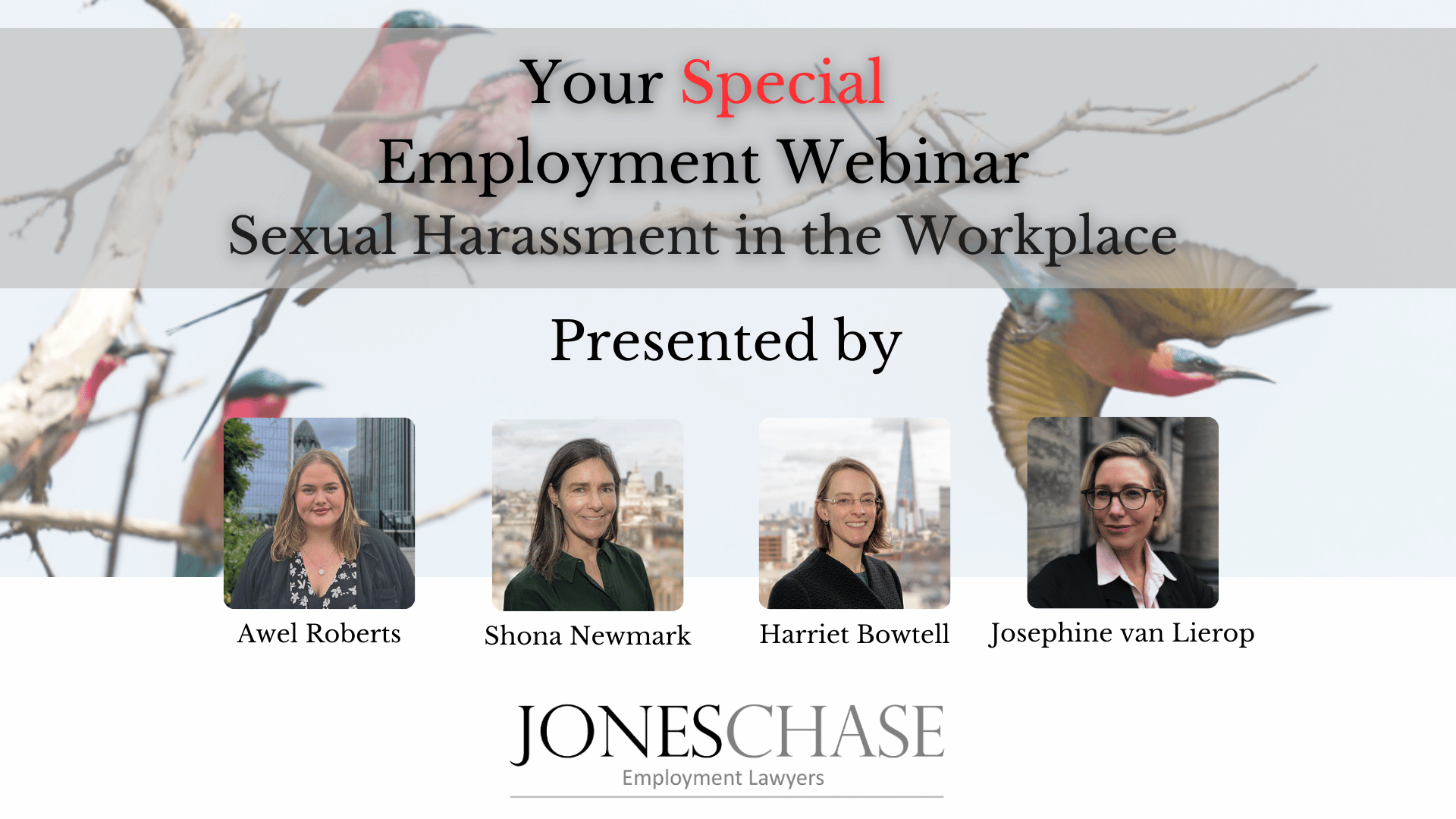
Led by Harriet Bowtell, Senior Associate, our experts at Jones Chase explored the current legal context behind sexual harassment, the new duty on employers and what practical steps can be taken to help compliance with the new duty.
In this part two, James provides some top tips for both employers and employees in dealing with unfair dismissal.

This week is stress awareness week.
Under the Management of Health and Safety at Work Regulations 1999, employers are required to make a ‘suitable and sufficient’ assessment of the risks to the health and safety of their employees.
As of 26 October 2024, there is a new proactive duty on employers to take “reasonable steps” to prevent the sexual harassment of their employees in the course of employment.

Further to our article on 18th July 2024 on 10th October 2024 the Government unveiled the details of the new proposed Employment Rights Bill ( ‘the Bill’), a full copy of which can be read here.
Once passed through Parliament, this will be recognised as the biggest update to Employment Rights in decades as the Bill proposes to introduce key reforms focusing on enhancing employment rights. We summarise the key proposals below.

For this webinar recording, we had the privilege of presenting alongside Lizzie Pickering, an expert who supports individuals and companies in navigating grief from various life changes including death, divorce, diagnosis and workplace change.

The new duty to prevent sexual harassment and what it means for employers
The Women and Equalities Select Committee published a report in 2018 which highlighted the extent to which sexual harassment in the workplace remains persistent. As a result, the government is bringing into force on 26 October 2024 the Worker Protection (Amendment of Equality Act 2010) Act 2023 which will:-

On 16 September 2024, Jones Chase was very proud to celebrate 10 incredible years in business.
Not enough gratitude can be expressed to the countless people who have been on this journey with us and who supported Jones Chase from the very start.
The King’s Speech on 17 July 2024 contained numerous employment law reforms. You can find a summary below of the bills the new government intends to introduce to Parliament and the policy priorities which do not require legislation.

We are pleased to share the final instalment of our trilogy of articles concerning sickness in the workplace, this article deals with long-term sickness.
In this second instalment of our trilogy of articles dealing with employment law issues surrounding sickness, we provide some key practical tips for employers. Employers need to think carefully about what to include in their sickness absence policy.

Sickness and sick pay are often difficult issues to deal with within the workplace. In this series of three articles, Simren Savjani and the other team members at Jones Chase explain some critical things for employers and employees to understand when dealing with sickness in the workplace. This first article deals with the concept of sick pay.
Jones Chase’s A-Z Employment Law Series In this video, James discusses the crucial aspects of unfair dismissal, including what makes

In today’s ever changing working environment, flexible working arrangements are rapidly becoming the norm. As organisations strive to attract and retain top talent, embracing flexibility has become a key competitive advantage.

We are incredibly proud to say that Jones Chase’s in-house band, Hot Damn! took part in the battle of the bands event at Law Rocks earlier this month.

The purpose of TUPE is to preserve the continuity of employment and terms and conditions of employees who are transferred to a new employer where a ‘relevant transfer’ takes place. TUPE is essentially a “statutory novation” of an employment contract.

Employment law has changed in a number of key areas in 2024 and employers need to update their policies, as an absolute minimum.
Several changes are to take place, and have taken place, in employment law in 2024. There are 9 major changes to be aware of.

This final instalment in our neurodiversity series focuses on practical strategies and resources that employers can implement to build inclusive workplaces and to attract and empower neurodivergent employees. Previously, in articles 1 and 2 we defined neurodiversity and explored relevant employment law legislation applicable to neurodiversity.
In our previous article, we explored essential neurodiversity-related terms and discussed the importance of recognising the diverse range of thinking styles and experiences. This article focuses on the legal landscape, specifically outlining employment law aspects that employers must understand to ensure compliance.
Understanding neurodiversity’s nuances is essential for building genuinely inclusive workplaces. This series aims to demystify the topic, providing employers and HR executives with practical strategies to empower and uplift neurodivergent employees.
The government has announced the annual increases to employment tribunal compensation limits and statutory redundancy payments. The new limits will apply where the relevant termination date is on or after 6 April 2024.

One of the core IWD missions this year is to forge inclusive work cultures where women’s careers thrive, and their achievements are celebrated.

Domonic discusses both the essential and commercial aspects of a contract of employment which should be considered when drafting the document.

We have rounded up the top five employment law changes for you to look out for in 2024. These changes will have considerable implications for both individuals and employers.

In this video, Jessica discusses garden leave – what it is, why it is used, and the effect it has on the contract of employment.

Christmas Special Employment Webinar recording, an in-depth review of key employment law developments from 2023 from the team.
The Government has announced the new rates of the National Living Wage and the National Minimum Wage which will come into force from April 2024.
In a recent podcast with Adam Hopkinson, Dean Jones, our Managing Partner, opens up about his journey, sharing stories of successes and challenges, whilst explaining his motivation behind why he chose to set up Jones Chase.

The Government has published its response to the consultation of ‘Retained EU employment law reforms’. The original consultation was seeking views on reforms to the Working Time Regulations (WTR) 1998, holiday pay and the Transfer of Undertakings (Protection of Employment) Regulations 2006 (TUPE). The consultation ran from 12 May to 7 July 2023.

There is a statutory obligation on employers to provide their employees and workers with a written statement of employment particulars as listed in section 1 of the Employment Rights Act 1996. These essential particulars are referred to as a “section 1 statement” and will often appear in a contract of employment.

On 20 July 2023, the Employment Relations (Flexible Working) Bill received Royal Assent. This will result in several changes to the current flexible working regime through the Employment Relations (Flexible Working) Act 2023:
On 18 September 2023, the Workers (Predictable Terms and Conditions) Act received Royal Assent. Due to come into force in around a year’s time, the Act will amend the Employment Rights Act 1996 to give certain workers, agency workers and employees a new statutory right to request a predictable work pattern if they meet the following criteria:
It is important that all stages of recruitment are carried out in a fair and non-discriminatory manner. This video presents some of the legal issues to consider when preparing and asking questions at the interview stage of a recruitment process.

A good culture within the workplace produces a variety of benefits which are seen by both the company and the employee. Organisations are continually striving to improve their workplace culture and individuals consider culture as a key factor in determining their next role. This article looks at the importance of a good culture within the workplace for employers and some tips on how to improve it.